
Baleno A/C compressor cutting on and off: how we find the cause
A compressor that engages, runs a few seconds and drops out again is usually being switched off by the system protecting itself. This is the order we work through to find out what is doing the switching.
 On this page
 What short cycling actually is
Every car A/C switches its compressor on and off. The question is how often. A system working properly holds the clutch in for minutes at a time in Chennai heat and releases it briefly once the cabin is cold. A system in trouble cuts every few seconds, and you can hear the click and feel the engine note change each time.
Count the seconds before you call anyone. A cycle measured in seconds points at pressure. A cycle measured in minutes, with the airflow fading before the cut, points at the evaporator icing instead. Those are two different repairs and the timing separates them before a single tool comes out.
The causes we work through, in order
1. A charge that is wrong in either direction
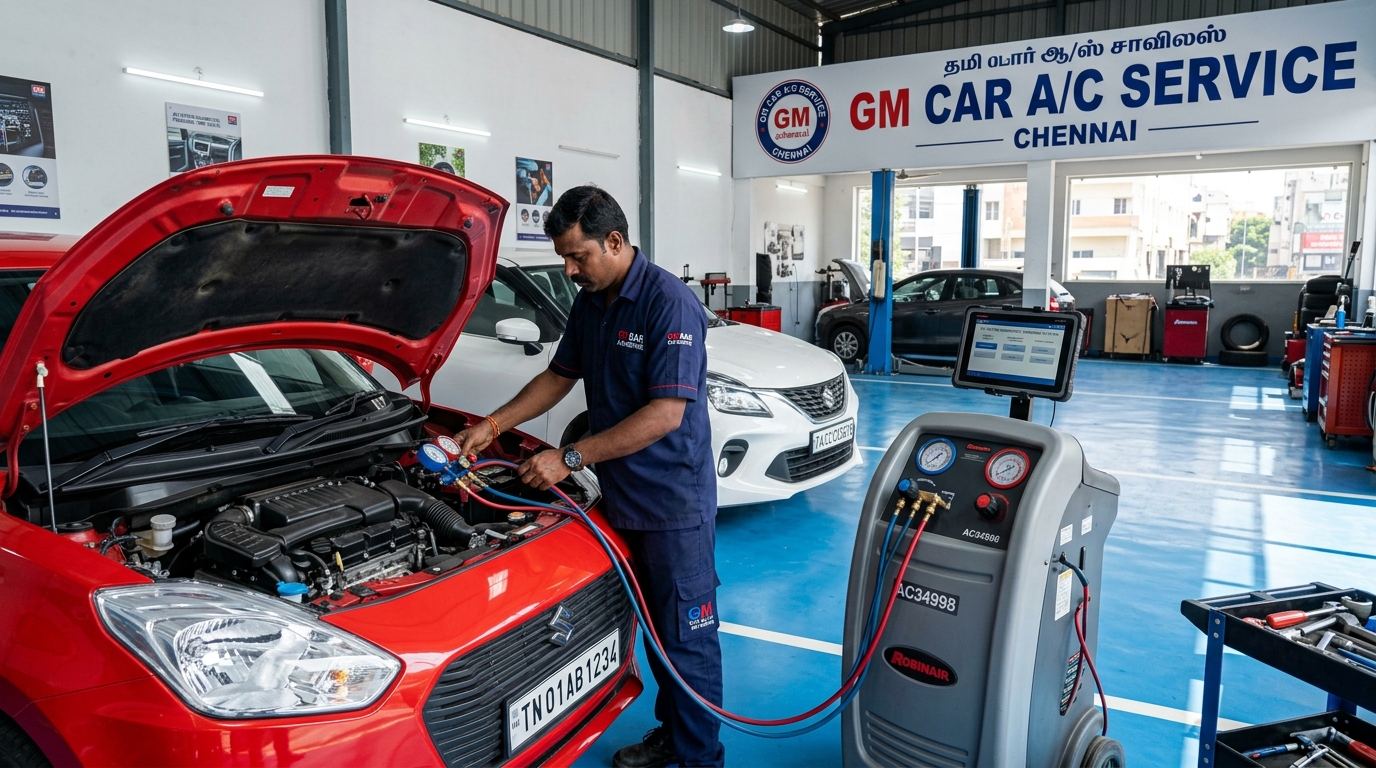
Too little refrigerant and the low-side pressure falls under the switch's floor, which is there to stop the compressor running without oil. Too much and the high side climbs until the cutout opens to protect the system. Both faults produce the same on-off pattern from the driver's seat, and a gauge set separates them straight away. Overcharge is common on cars that have been topped up by feel rather than by weight.
2. A condenser that cannot shed heat
The condenser sits at the front of the car, ahead of the radiator and behind the bumper, and it packs with dust, insects and road film. Maruti is the brand we see most in the workshop, and on the hatchbacks a blocked condenser face is the first thing we look at when the complaint is cycling in traffic. High-side pressure climbs because the heat has nowhere to go, the switch opens, and cooling returns as soon as the car moves and air passes through again. Cleaning the face is often the entire repair.
3. The cooling fan not running when it should
The fan is what makes the condenser work while the car is standing still. A failed relay, a tired motor or a fan that never gets the command produces exactly the symptom above and only in traffic. This is measured, not guessed: either the fan is commanded on with the A/C and turning, or it is not.
4. Icing on the evaporator
If the cabin filter is blocked or the blower is weak, not enough air passes over the evaporator, its surface drops below freezing and frost builds up. Airflow fades, the compressor is cut until the ice clears, and cooling comes back a few minutes later. The give-away is that the airflow drops before the cooling does.
5. A worn clutch air gap
The clutch face wears and the gap between plate and pulley widens. The magnet still pulls the plate across but cannot hold it under load, so it grabs and slips. The gap is a measurement, and on many compressors it is a shim adjustment rather than a part.
6. The engine control unit doing its job
A brief cut under hard acceleration, or with the steering held on full lock at idle, is the car deciding the engine has more urgent work. That is normal and it is short. It is worth ruling out before anything is opened, because nothing is wrong.
The charge figure is on the label, not in the manual
Maruti does not publish the A/C refrigerant charge for the Baleno in the India owner's manual. Some brands do and we use their figure; for this car there is no published number to use, and we will not take one from an aftermarket chart or from a manual written for another market. Charts like that are averages across variants and model years, and an average is how a system ends up overcharged.
The number that counts is on the label under the bonnet, usually on the slam panel or a strut tower, and it is specific to the car in front of you. Open the bonnet and read it. Any workshop putting gas into your car should be able to show you that label and tell you what it is recovering and what it is charging back, by weight.
What the checks cost
The free 30-point A/C and electrical checkup is ₹0, takes about fifteen minutes and produces a written report you keep whether or not the work is done here. It is what tells us which of the six causes above is yours.
If the answer is the charge, a gas fill is ₹1,500 for a single module and ₹2,200 for a double, and the leak check is included in both. If the answer is the compressor itself, we quote after the diagnosis and not before it: the gap between a relay and a replacement is too wide for a printed number to be honest.
Frequently asked questions
Is my Baleno compressor failing if it cuts in and out?
Usually not. Cycling is what the protection circuits do when a pressure reading goes outside the safe band, so the compressor stopping is the system working rather than breaking. A failing compressor more often makes a metallic noise that changes with engine speed, or leaves the high and low pressures refusing to separate while the clutch is engaged.Why does the cooling stop in traffic and come back once I am moving?
That pattern points at the condenser or the cooling fan. Standing still, the fan is the only thing pushing air through the condenser, so a blocked face or a fan that is not turning lets the high-side pressure climb until the cutout opens. Moving forces air through again and the pressure falls back into range.How much refrigerant does a Baleno take?
Maruti does not publish that figure in the India owner's manual, so the only reliable source is the label under the bonnet of your own car. We charge by weight against that label after recovering what is in the system, rather than filling to a chart figure that was averaged across variants.Get Your Free 30-Point Checkup
We reply in workshop hours · No spam
Prefer to talk? Call +91 8428000085 or WhatsApp us.
Related services
See Maruti Suzuki service in Chennai, A/C compressor repair, and the published rate card.
If the clutch never engages at all, that is a different fault: read compressor clutch not engaging. If you have been told the compressor is finished, read how we decide whether it really needs replacing.